Small Doses, Big Shifts: The Case for Ditching Your All-or-Nothing Wellness Routine

Let's be honest. The 90-minute yoga class, the 45-minute meditation sit, the elaborate morning ritual that requires waking up before the sun—these things are beautiful in theory. In practice? Most of us are lucky to string together 20 uninterrupted minutes on a Tuesday.
And yet, somewhere along the way, we absorbed the idea that if we couldn't do wellness fully, we shouldn't bother at all. That belief might be the most damaging thing the wellness industry ever sold us.
Here's what's actually true: a growing body of research suggests that short, intentional moments of stillness, movement, or breath work—scattered organically throughout your day—can produce measurable, lasting shifts in your nervous system, your mood, and your creative output. The all-or-nothing mentality isn't protecting your practice. It's keeping you from having one.
The Science of the Micro-Moment
Your nervous system doesn't care how long you showed up. It cares that you did.
Researchers at Harvard Medical School have documented the physiological impact of even brief mindfulness interventions—as short as three minutes—on cortisol regulation and heart rate variability. Meanwhile, a 2021 study published in Psychological Science found that participants who took short movement breaks every 30 minutes reported significantly lower stress levels and higher cognitive clarity than those who saved their movement for a single longer session.
The mechanism here is elegant. Every time you take a conscious breath, step outside for a two-minute walk, or drop your shoulders and soften your jaw, you're sending your autonomic nervous system a signal: we are safe right now. Do that five, six, seven times a day, and you're essentially reprogramming your baseline stress response—not through one dramatic retreat weekend, but through consistent, gentle repetition.
Think of it like watering a plant. A daily splash beats a monthly flood every time.
What a Micro-Practice Actually Looks Like
The beauty of this approach is that it's radically customizable. There's no single prescription, no app you have to buy, no perfect sequence to memorize. Some entry points that our community has found genuinely useful:
The Desk Reset. Set a timer for every 45 minutes while you're working. When it goes off, stop. Take five slow breaths—inhale for four counts, exhale for six. Roll your neck gently. Feel your feet on the floor. That's it. You just completed a micro-practice.
The Threshold Pause. Before you walk through any door—your office, your kitchen, your kids' school—pause for one breath. Notice where you are. This isn't woo; it's a neurological pattern interrupt that keeps you from running on autopilot all day.
The Walking Window. Your lunch break, your parking lot walk, your trip to the mailbox—any of these can become a moving meditation. Leave your phone in your pocket. Feel the ground under your feet. Notice five things you can see. You've just moved your body and your mind simultaneously.
The Creative Minute. Keep a sketchbook, a journal, or even a notes app within reach. Give yourself 60 seconds to draw a shape, write a sentence, or hum something. This isn't about making art—it's about signaling to your nervous system that you're a person who creates, not just a person who produces.
Challenging the Hustle-Wellness Paradox
There's something quietly radical about reclaiming wellness from the performance of wellness. American culture has a particular gift for turning rest into another item on the productivity checklist—we optimize our sleep, gamify our step counts, and turn our meditation streaks into social currency.
Micro-practices resist that. They don't photograph well. They don't generate content. They just work.
And maybe that's the point. When you stop treating your wellbeing as something that requires a perfect window of time, a dedicated studio space, or the right playlist, you start finding it everywhere. In the pause before you answer an email. In the moment you choose to look out the window instead of at your screen. In the three deep breaths you take before a hard conversation.
Building Your Own Micro-Practice Architecture
If you want to get intentional about this—and we think you do, or you wouldn't be here—start by auditing your day for natural seams. Not empty time, but transitional time. The space between tasks, between meetings, between roles.
Those seams are where your practice lives now.
Choose two or three anchor moments—specific, recurring points in your day where you'll drop in intentionally. Morning coffee. The school pickup line. The moment before you open your laptop. Attach a small ritual to each one. Keep it under five minutes. Keep it consistent.
Within two weeks, those moments will start to feel less like interruptions and more like the connective tissue of your day. The practice isn't happening despite your busy life. It's woven into it.
That's not a compromise. That's actually the whole point.
The Longer Practice Isn't Going Anywhere
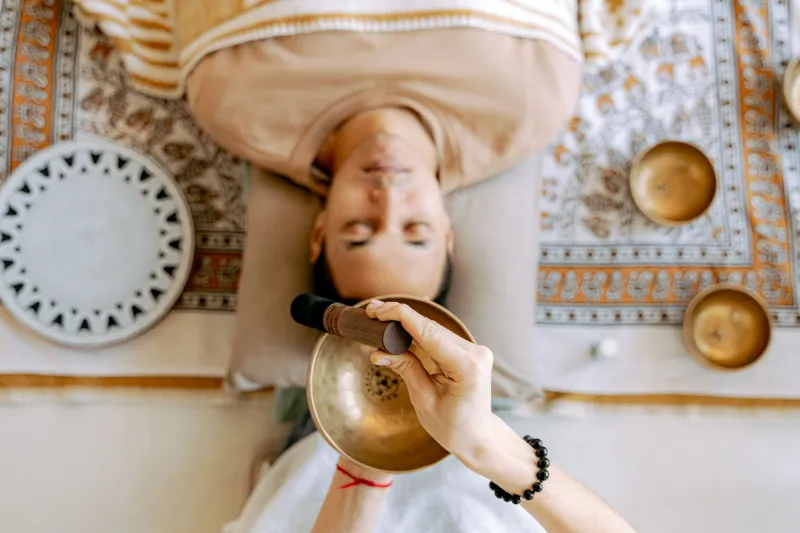
None of this means you should abandon your Sunday morning flow or your monthly sound bath. Those longer, deeper immersions serve a different function—they're where you integrate, reset, and go deeper into your own interior landscape. We believe in those experiences wholeheartedly.
But they work better when your nervous system is already tuned up from the daily micro-doses. The hour-long practice becomes more potent when it isn't doing all the heavy lifting alone.
Think of the micro-practice as maintenance. The longer session as transformation. You need both—but you can start with what you actually have.
Five minutes. Right now. That's enough.