Your Body Has Been Keeping the Score — Here's How to Finally Listen
Somewhere around your third therapy session, you might have noticed something: you can describe what happened to you with startling clarity. You know the timeline. You understand the patterns. You've traced the roots back to their source.
And yet, the tightness in your chest when your phone rings with an unknown number—that hasn't changed. The bracing that happens in your shoulders when someone raises their voice. The inexplicable exhaustion that descends after a social event you genuinely enjoyed.
Your mind knows the story. Your body is still living it.
This is the territory that somatic healing moves into—the space where language ends and sensation begins. And for a growing number of Americans, it's the missing piece.
What Somatic Actually Means (And Why It Matters)
The word somatic comes from the Greek soma, meaning body. Somatic practices are, at their core, body-centered approaches to healing—modalities that work with physical sensation, movement, breath, and nervous system regulation rather than (or alongside) cognitive processing.
Dr. Bessel van der Kolk's landmark work The Body Keeps the Score brought this concept into mainstream consciousness, documenting how traumatic experience doesn't just leave psychological imprints—it reshapes the physiology. The muscles, the fascia, the breath patterns, the gut. Trauma, stress, and unprocessed emotion find places to live in the body, and they tend to stay there until the body itself is invited into the healing.
"Most of the clients I work with have done significant cognitive work," says Mariana Reyes, a somatic experiencing practitioner based in Denver. "They're incredibly self-aware. But awareness alone doesn't always move the needle on how they feel in their bodies day to day. That's where we start to work with sensation, with posture, with breath—and things begin to shift in ways that can genuinely surprise people."
The Landscape of Embodied Practices
Somatic healing isn't a single modality—it's more of an umbrella covering a rich and varied terrain. Here's a brief map:
Somatic Experiencing (SE) was developed by Dr. Peter Levine and focuses on completing the body's interrupted stress responses. Think of the way an animal shakes after escaping a predator—that's the nervous system discharging. SE helps humans access similar completion cycles that modern life often suppresses.
Sensorimotor Psychotherapy integrates body awareness into traditional talk therapy, helping clients notice the physical sensations that arise alongside emotions and memories, then work with those sensations directly.
Continuum Movement is a practice developed by Emilie Conrad that uses breath, sound, and fluid movement to access the body's innate intelligence. It looks less like exercise and more like listening.
Trauma-Sensitive Yoga adapts traditional yoga postures to emphasize choice, agency, and interoception—the ability to sense what's happening inside your own body—rather than alignment or achievement.
TRE (Tension and Trauma Releasing Exercises) uses a series of gentle movements to trigger the body's natural tremoring mechanism, releasing deeply held muscular tension.
Each of these approaches starts from the same premise: the body isn't just a vehicle for the mind. It's an intelligent, responsive system with its own memory, its own language, and its own capacity for healing.
What the Body Remembers That the Mind Glosses Over
Here's something worth sitting with: you've been breathing your whole life, and you've almost certainly developed a breathing pattern that reflects your emotional history. Shallow chest breathing is often a signature of chronic anxiety. Breath-holding tends to accompany the anticipation of threat. Collapsed posture frequently mirrors an old story about taking up too much space.
None of this is conscious. That's precisely the point.
"The body adapts to protect us," explains Tomás Guerrero, a movement therapist and certified SE practitioner in Austin, Texas. "A child who grew up in an unpredictable environment might learn to make themselves physically smaller, to breathe less, to move through space as unobtrusively as possible. That was adaptive then. But those patterns persist into adulthood, and they shape everything—how we carry ourselves, how we relate to others, how much space we feel entitled to take up in the world."
Becoming aware of these patterns—not just intellectually but sensorially—is where the work begins.
Practices You Can Start Today
You don't need a therapist's office to begin developing embodied awareness. These are starting points:
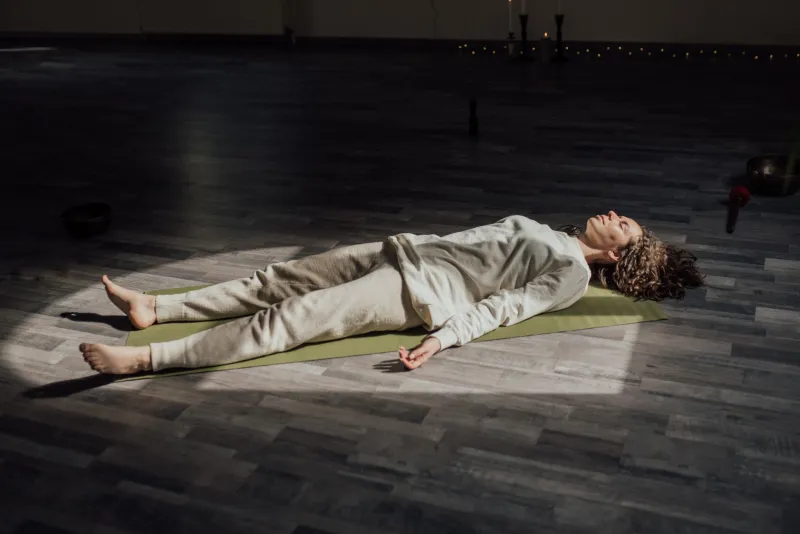
The Body Scan. Lie down or sit comfortably. Starting at the crown of your head, slowly move your attention down through your body—not trying to change anything, just noticing. Where is there warmth? Tension? Numbness? Tingling? This practice builds interoceptive awareness over time.
Orienting. This is a technique from Somatic Experiencing. Slowly look around the room you're in, letting your eyes rest on objects that feel neutral or pleasant. Notice what happens in your body as you do. This activates the social engagement system and signals safety to the nervous system.
Shaking and Tremoring. Stand with feet hip-width apart, bend your knees slightly, and begin to let your body bounce gently. After a minute or two, stop and stand still. Notice if you feel any spontaneous tremoring or vibration. Don't suppress it—let it move through.
Expressive Movement. Put on a song that matches your current emotional state and move however your body wants to move—not how you think you should. This isn't dance class. It's permission.
The Invitation Back Into Yourself
For many of us, the body has felt like a problem to manage rather than a home to inhabit. We've been trained to override its signals—push through fatigue, suppress emotion, optimize performance. Somatic work is, in many ways, an act of radical return.
It's slow. It's nonlinear. It doesn't always look like progress from the outside.
But there's something that happens when you start actually listening to your body—when you stop treating sensation as noise and start receiving it as information. A kind of coming home that no amount of cognitive insight can fully replicate.
Your body has been with you through everything. It deserves to be part of the healing too.