The Ceiling Only You Can Hit: Why Your Solo Practice Needs Witnesses
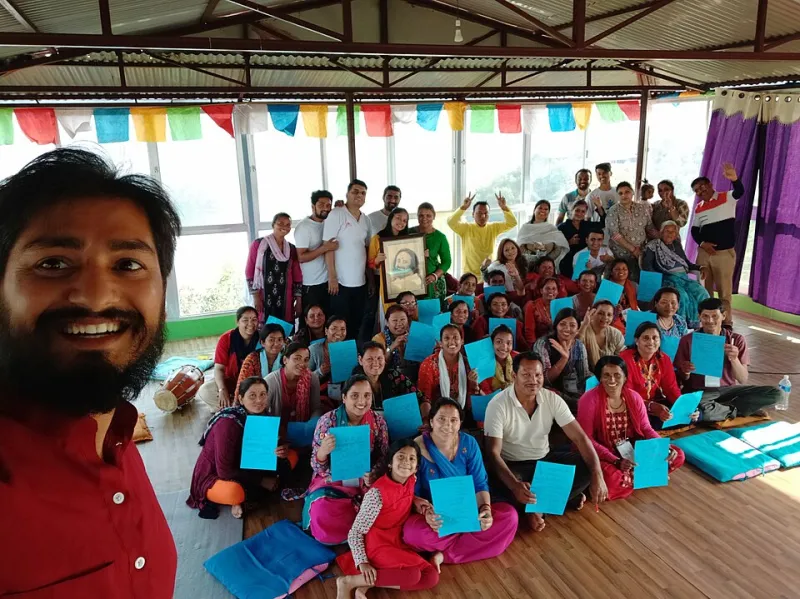
Photo: Yogacharya Rajendra, CC BY-SA 4.0, via Wikimedia Commons
You've done the work. You've got the cushion in the corner, the mat that's actually broken in, the playlist you queued up back in February. Your solo practice is real — and that's exactly why this might sting a little to hear:
It's probably plateaued.
Not because you're lazy. Not because you need a better app. Because practicing alone, no matter how devoted, has a structural limit that no amount of willpower can push through. And the fix isn't another retreat or a $180 membership. It's other people.
The Nervous System Is a Group Project
Scientists call it co-regulation: the well-documented phenomenon where two or more nervous systems, in proximity, begin to settle and synchronize. Heart rates drop together. Breathing patterns align — literally, without anyone being asked to "breathe together." Your vagus nerve, the main highway of your calm, responds to social cues faster than it responds to any app prompt.
This is why the group meditation you almost skipped can leave you feeling rearranged in a way your kitchen cushion hasn't managed in months. It's why singing in a circle hits different than singing in the shower. It's why a run club at 7 a.m. in a park in Denver or Atlanta or Portland gets people out of bed when no alarm ever could.
Your solo practice maintains. A shared practice elevates. You need both — but most of us only have one.
Where Solo Tops Out
There are three ceilings that show up again and again in home practice:
The effort ceiling. Alone, you go exactly as deep as you feel like going that day. In a room full of people holding a pose, humming a drone, or sitting in stillness, the group carries you ten percent further than your motivation would. Ten percent, compounded over years, is a different life.
The honesty ceiling. Nobody witnesses your practice, so nobody notices when you start phoning it in. A teacher who's seen you three Tuesdays in a row will clock the difference before you do.
The imagination ceiling. We copy ourselves. Same sequence, same songs, same insights on loop. Other people bring material you'd never generate alone.
Finding Your People Without Spending a Dime
The good news: practice communities are having a moment, and most of them are free or close to it.
Run clubs. They've exploded across American cities — often hosted out of running shoe stores or breweries, and almost always free. Show up, move, stay for the social hour. That's a practice community with a cardiovascular base.
The kitchen-table song circle. This one you build yourself. Invite four people over, tell them to bring whatever instrument they own (a voice counts), and take turns. No performance, no phones, no audience — just shared sound. Old-time and folk traditions in Appalachia and across the South have known for centuries what neuroscience is now confirming: making music together regulates the room.
Free community classes. Many yoga studios offer donation-based or community classes at off-peak hours. Libraries, parks departments, and community centers host free meditation and movement groups that never make it onto Instagram. Search your city's calendar, not the algorithm's.
The standing date. If nothing exists near you, the bar is low: one friend, one hour, one recurring time. A weekly walk-and-talk, a shared sketch hour at a coffee shop, a Sunday breath sit over video when distance gets in the way. Consistency with one witness beats sporadic crowds.
Keep the Home Practice — Change Its Job
None of this means your solo time was wasted. It's the foundation. But reassign the roles: let the home practice be maintenance, and let the shared practice be where you stretch. One anchors you; the other lifts you.
Rise into your practice. Then find the room — and the people — that raise it.