Permission to Be Mediocre: Why Your Nervous System Craves a Truly Terrible Drawing
Photo: Francisco Goya, CC0, via Wikimedia Commons
The first thing most of us do after making something bad is apologize for it. The second is hide it. The third is quietly decide not to make anything again for a while.
Watch a room of adults at a paint-and-sip night and you'll see it: forty people gripping brushes like they're signing mortgage documents, producing perfectly pleasant little landscapes and then announcing, unprompted, that they are not artistic. Nobody asked. The apology arrives on its own, like a reflex.
I want to make a case for the opposite instinct. Not try your best and accept the outcome — that's just perfectionism in a cardigan. I mean make something deliberately bad, on purpose, with a timer running, and notice what happens in your shoulders.
The Hidden Cost of Always Getting Good
Perfectionism isn't a personality quirk. It's a physiological posture. Shoulders up. Breath shallow and high in the chest. Jaw doing something it shouldn't. The body treats an evaluated task the way it treats a threat, because in a small but real way, it is one: there's a correct answer out there and you might fail to produce it.
That's fine for a tax return. It's corrosive for creativity, which runs on wandering, testing, and being wrong in interesting directions. And it's corrosive for a nervous system that never gets the message that a room full of materials is a safe place to be.
Non-Judgment Is a Skill, Not a Mood
Yoga teachers talk about santosha — contentment, the practice of meeting what's actually here instead of what you wish were. And about ahimsa, non-harming, which absolutely includes the way you talk to yourself about your own linework.
Meditation makes the same move from a different angle. You don't sit down and command your mind to be quiet. You sit down, notice you've drifted into a story about how you're bad at meditating, and come back to the breath. The noticing is the practice. The return is the practice.
Transfer that to a sketchbook and something clicks: the thought this is ugly is not a verdict. It's just a thought arriving, and you can let it pass without putting down the pencil.
What Low Stakes Actually Does for the Body
The research on play keeps landing in the same neighborhood — unstructured, outcome-free activity tends to lower stress markers and loosen the grip of rumination. The mechanism isn't mystical. When nothing is at risk, the threat response has nothing to latch onto, and the body gets a reprieve from bracing.
Deliberate badness is that reprieve with a handle on it. Instead of hoping you'll stumble into low stakes, you engineer them. You declare, out loud, that the goal is a bad drawing. Now there is no failure state. You cannot miss a target you deliberately aimed at the floor.
The Fifteen-Minute Bad Art Ritual
Try this at home, or in a studio if you have one nearby that rents open time.
Minute 0 to 3 — Set up like a kid. Choose the humblest material you own. Crayon. Cheap air-dry clay. A charcoal stick that will absolutely get everywhere. A spiral notebook from a drugstore. Keep it under three items.
Minute 3 to 5 — Pick one stupid constraint. Draw only with your non-dominant hand. Use a single color. No erasing. Only circles. Clay with your eyes half-closed. The constraint is there to keep the inner critic busy filing paperwork.
Minute 5 to 12 — Make, phone face down. Not in another room — you'll get up. Face down on the table where you can see it and refuse it.
Minute 12 to 14 — Look without commentary. Then write one neutral sentence in the margin. The left side got heavy. The green is doing something strange. This cup leans. Observations, not grades. The difference between the green is doing something strange and the green is wrong is the entire practice.
Minute 14 to 15 — Decide nothing. Keep it or compost it. Both are correct. If you keep it, put it in a folder labeled Evidence and don't open the folder again this month.
Three Variations for People Who Don't Draw
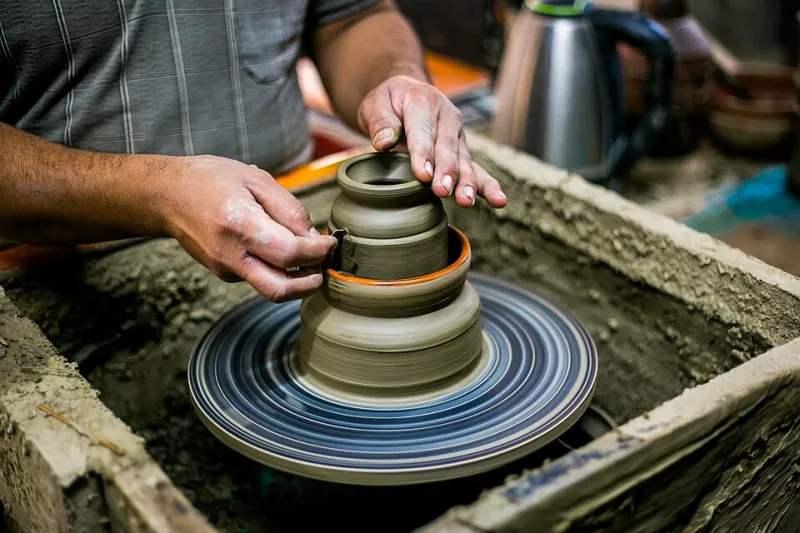
- Clumsy pottery. Make the lopsided cup. Aim for a vessel that will hold a pen and nothing else. The wheel will humble you and that's the point.
- Awkward movement. Put on one song and improvise badly. Falling out of the phrase is not a mistake, it's the assignment. Bonus points if you laugh.
- Off-key humming. Sing something you don't know well, badly, in the car. Notice the urge to stop when you flatten a note. That urge is what we're training against.
The Part That Makes It Stick
Once a week, same time, same material. Don't photograph it. Don't post it. Tell exactly one person you're doing it, so there's a witness to the habit without an audience for the output.
And here's the payoff nobody expects: after a couple of months of bad art, the good work gets braver. Critique lands better when your body is calm enough to hear it. You stop protecting a reputation you never actually had, and start making the strange, specific things you were always going to make.
Start ugly. Stay curious. It's the only reliable way in.