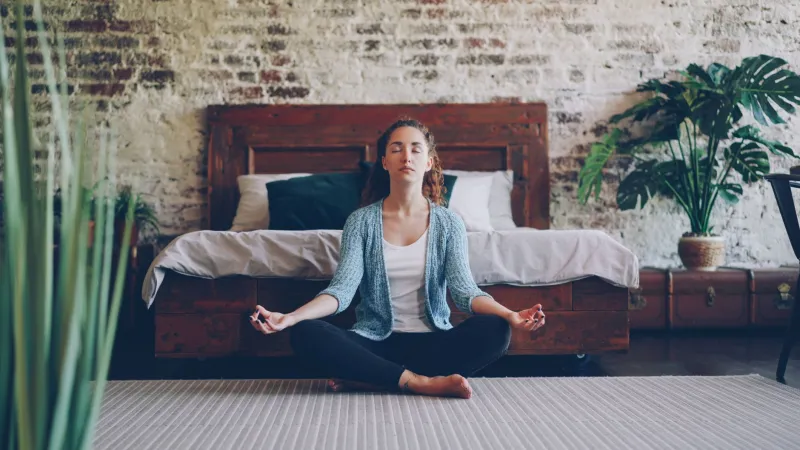
Still Mind, Wild Art: How Meditation Is Quietly Becoming Every Creative's Secret Weapon
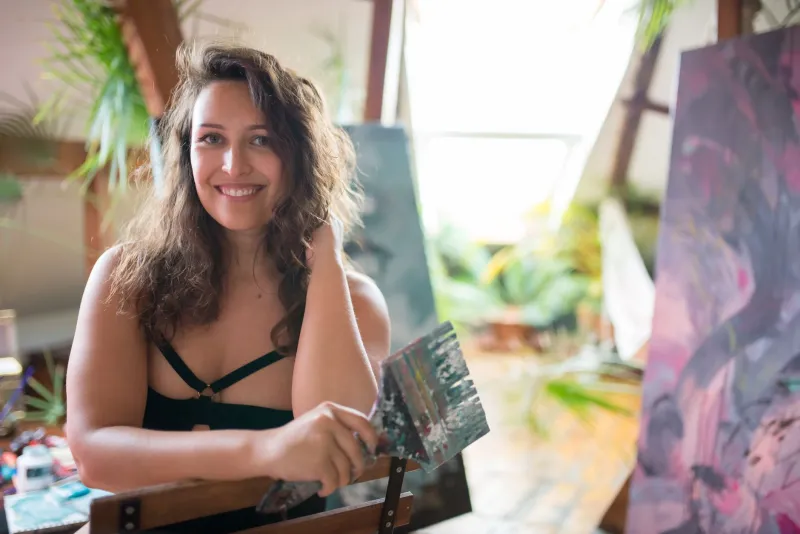
There's a particular kind of creative suffering that most artists know intimately. You sit down to paint, write, compose, or design, and instead of flow, you get noise. Self-criticism. Comparison. The blank canvas becomes an accusation. The cursor blinks like it's mocking you.
For a long time, the cultural narrative around that suffering was almost romantic — the tortured artist, the muse that comes and goes on its own schedule. But a growing number of creatives across the US are quietly dismantling that myth, replacing the romantic chaos with something more radical: a daily meditation practice.
And the results they're describing aren't subtle.
The Neuroscience of Creative Stillness
Before we get into the stories, it's worth understanding why meditation and creativity are such a natural pairing on a neurological level.
Creative breakthroughs — those flashes of unexpected connection, the sudden solution to a design problem, the lyric that arrives fully formed — are associated with what researchers call the default mode network (DMN). This is the brain's introspective system, active when we're daydreaming, recalling memories, imagining futures, or simply letting our minds wander without a specific task.
Here's the paradox: the DMN is suppressed when we're anxious, stressed, or hyperfocused on performance outcomes. In other words, when you're trying too hard to be creative, you're actively blocking the neural network most responsible for creative insight.
Meditation — particularly open-monitoring practices, where you observe thoughts without attachment rather than focusing on a single object — has been shown to increase DMN activity and flexibility. A 2012 study in Frontiers in Psychology found that open-monitoring meditation significantly boosted divergent thinking, the cognitive process behind generating novel ideas. The still mind, it turns out, is the wild mind.
From the Studio: Artists Who Made the Shift
Maya, Painter — Los Angeles, CA
Maya has been a working abstract painter in LA for over a decade, selling through galleries in Silver Lake and showing at regional art fairs. Two years ago, she hit a wall — not creatively, she says, but emotionally. "I was making work I didn't care about anymore. I was painting for the market, second-guessing every brushstroke. It felt like manufacturing, not art."
A friend dragged her to a silent meditation retreat in Joshua Tree. She went skeptically. She came back changed.
"The retreat was ten days. No talking, no phone, no input. By day four, I started seeing color differently — like, literally. The quality of light in the desert looked almost psychedelic. I realized I'd been so in my head about painting that I'd stopped actually seeing."
She now meditates for 20 minutes every morning before entering her studio, practicing a simple breath-awareness technique — following the inhale and exhale without manipulation. "It's like clearing the cache before I open the file. My work got weirder and more honest almost immediately."
The technique Maya uses — focused attention meditation, anchoring awareness to the breath — is particularly useful for visual artists because it trains sustained, non-judgmental observation. You practice looking without labeling. That carries directly into how you see your subject or your canvas.
DeShawn, Musician and Producer — Atlanta, GA
DeShawn produces hip-hop and R&B in Atlanta, working with both independent artists and major label clients. His challenge wasn't creative block — it was creative overwhelm. "I had too many ideas, too much noise. I couldn't finish anything because something new would come and I'd chase it."
He stumbled into Transcendental Meditation (TM) after seeing a documentary about David Lynch's use of the practice. TM involves the silent repetition of a personal mantra, practiced for 20 minutes twice daily, and has an unusually strong body of research behind it, including studies linking it to reduced anxiety and improved cognitive flexibility.
"TM slowed my brain down in a way that nothing else had. I started finishing tracks. Not because I was being disciplined — but because I could hear what the song actually needed instead of what I thought it should be."
For musicians and producers, mantra-based meditation offers something specific: it quiets the inner critic that's constantly evaluating pitch, rhythm, and arrangement while you're trying to create. That evaluation is necessary — but not while the raw material is forming.
Priya, UX Designer and Illustrator — Brooklyn, NY
Priya works in tech by day and illustrates editorial work by night. She came to meditation through a corporate wellness program — "very reluctant, very eye-rolly," she laughs — but stayed because of what it did to her problem-solving.
"In UX, you're constantly stuck between user needs and business constraints. It's a puzzle with no clean solution. I started noticing that my best ideas weren't coming at my desk — they were coming in the shower, or on the subway, or right when I woke up. Meditation taught me to access that state more intentionally."
Her practice is a hybrid: she starts with five minutes of body scan meditation (moving awareness systematically through the body), then transitions into what she calls "question sitting" — she holds a specific design challenge in her mind without trying to solve it, then releases it and simply breathes. "About 60 percent of the time, something useful comes up. Not always the answer, but a new angle."
This approach mirrors what researchers call incubation — the cognitive stage where the unconscious mind continues processing a problem after conscious effort is suspended. Meditation creates a reliable container for that incubation to happen on purpose.
Matching Your Practice to Your Discipline
Not all meditation is the same, and different creative disciplines seem to resonate with different approaches.
Visual artists tend to thrive with open-awareness or sensory meditation practices — techniques that sharpen non-judgmental perception and expand the quality of attention brought to visual input.
Writers often find loving-kindness meditation (Metta) particularly useful, since so much of writing requires empathy and the ability to inhabit other perspectives. Softening the inner critic through self-compassion practices can also break through perfectionism-driven blocks.
Musicians and composers frequently benefit from mantra-based or sound-focused practices, which attune the practitioner to rhythm, resonance, and the quality of silence between sounds.
Designers and strategic thinkers tend to respond well to body scan and breath-focused practices that regulate the nervous system and create the calm clarity needed for integrative problem-solving.
The Practice Itself Is Creative
One thing every artist we spoke with mentioned, unprompted, was that meditation changed their relationship to the process of making — not just the output.
When you sit with discomfort in meditation, when you watch a difficult thought arise and pass without acting on it, you're building a tolerance for the uncertainty that all creative work requires. You learn that the blank canvas isn't an emergency. That the silence before the lyric is part of the song.
At Elevated Sol, we've always believed that art and wellness aren't parallel tracks — they're the same path. Meditation doesn't make you a better artist by filling you up. It makes you better by clearing the way for what was always there.
Sit down. Get still. Then make something wild.